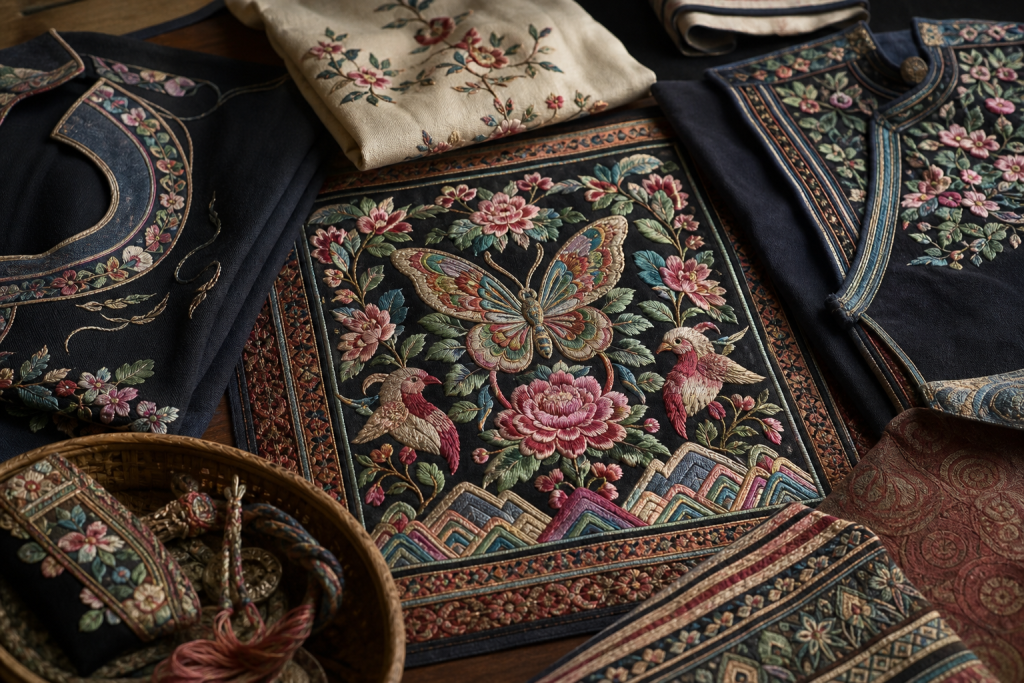
The first thing many people notice in Yunnan old embroidery is colour. The second is movement. Flowers open across the chest, birds sit in mirrored pairs, butterflies appear between vines, and borders frame the body like a textile architecture.
These motifs should be read with humility. Yunnan is home to many communities and local traditions, and symbolism changes by place, maker and period. A flower is not always a single fixed message. A border is not only decoration. The safest and most respectful way to look is to notice relationship: motif to garment, colour to cloth, and image to use.

Motifs create structure
On many embroidered garments, the strongest work appears where the eye naturally lands: collars, cuffs, hems, chest panels and backs. These areas turn clothing into a frame for storytelling. A small vest may feel architectural because its borders are so deliberate; a long coat may feel ceremonial because embroidery travels with the movement of the body.
Symmetry is also important. Mirrored birds or balanced floral panels can make a garment feel calm and formal, while freer vines and scattered blossoms can create a softer, more expressive surface. Neither is better. They simply carry different energy.
Colour is part of the language
Deep indigo, black ground cloth, cinnabar red, jade green and aged gold often appear especially rich in old embroidered pieces. Strong contrast helps the motif read from a distance; close tonal shifts reward the person who looks nearer.
When choosing a piece, ask what the motif does to the whole garment. Does it sharpen the shoulder line? Does it soften the front? Does it make the back more powerful than the front? Good embroidery is not only beautiful in detail; it changes how the garment occupies space.